
Disease-Modifying Therapies for
the Lungs
Pipeline
LAM-001 FOR PH-ILD
About PH
Pulmonary hypertension (PH) is a heterogeneous collection of disorders characterized by elevated pressure in the pulmonary vasculature. The pathology in the pulmonary arteries is caused by adverse vascular remodeling, culminating in hypertrophy and failure of the heart’s right ventricle.
A subset of patients develops PH in the context of underlying chronic lung disease, such as interstitial lung disease (ILD). ILD encompasses a broad group of disorders, including idiopathic pulmonary fibrosis (IPF), connective tissue disease-associated ILD (CTD-ILD), and non-specific interstitial pneumonia (NSIP), and is characterized by inflammation and fibrosis of the lung tissue—ultimately leading to progressive scarring and impaired gas exchange. When PH develops in the setting of ILD (PH-ILD), the combined burden of lung tissue injury and vascular remodeling is associated with more severe functional outcomes and a markedly worse prognosis. Approximately 86,000 patients in the United States and 120,000 patients across Europe are estimated to be affected by PH-ILD.
Other than lung transplantation, there is no known cure for PH-ILD. The only therapeutics currently FDA-approved to treat PH-ILD are Tyvaso® and Yutrepia®, which are both prostacyclin analogues that require three to five administrations daily.
mTOR Signaling in PH
Across multiple disease models, mTOR signaling has emerged as a central driver of pulmonary vascular hyperproliferation and parenchymal fibrosis, and mTOR inhibition has been shown to reverse or prevent disease. Non-clinical studies have shown consistent benefit of mTOR inhibition on reversing pulmonary arterial smooth muscle cell (PASMC) hyperproliferation, on improving vascular structure, and on ameliorating right-heart strain. Furthermore, early human experience with oral mTOR inhibitors demonstrated feasibility and biologic activity in patients with severe PH.
In addition to its promotion of vascular smooth muscle hyperproliferation, hyperactive mTOR signaling promotes fibroblast activation, myofibroblast differentiation, and extracellular matrix deposition in injured or inflamed lung tissue. Rapamycin has been shown to reduce collagen accumulation and to attenuate parenchymal fibrosis. Separately, rapamycin limits inflammatory cell recruitment and down‑regulates cytokine pathways that drive pulmonary vascular and parenchymal injury, providing a complementary anti‑inflammatory mechanism relevant in PH‑ILD.
Investigating LAM-001 for PH
Data from a proof-of-concept Phase 2a trial (NCT05798923) studying LAM-001 in 10 adult patients with pulmonary arterial hypertension (PAH) and PH-ILD was presented at the American Thoracic Society in May 2026. In this open-label study, the four adult patients with PH-ILD treated with LAM-001 demonstrated a mean improvement in 6MWD of 67.4 meters and a mean pulmonary vascular resistance (PVR) (supine) reduction of 33.9% at 24 weeks. A mean 6MWD improvement of 81.3 meters and a mean PVR (supine) reduction of 28.1% was seen in the combined population of six evaluable PAH and PH-ILD patients. These benefits were seen on top of stable doses of standard of care agents, including treprostinil. The drug was generally well tolerated in both populations.
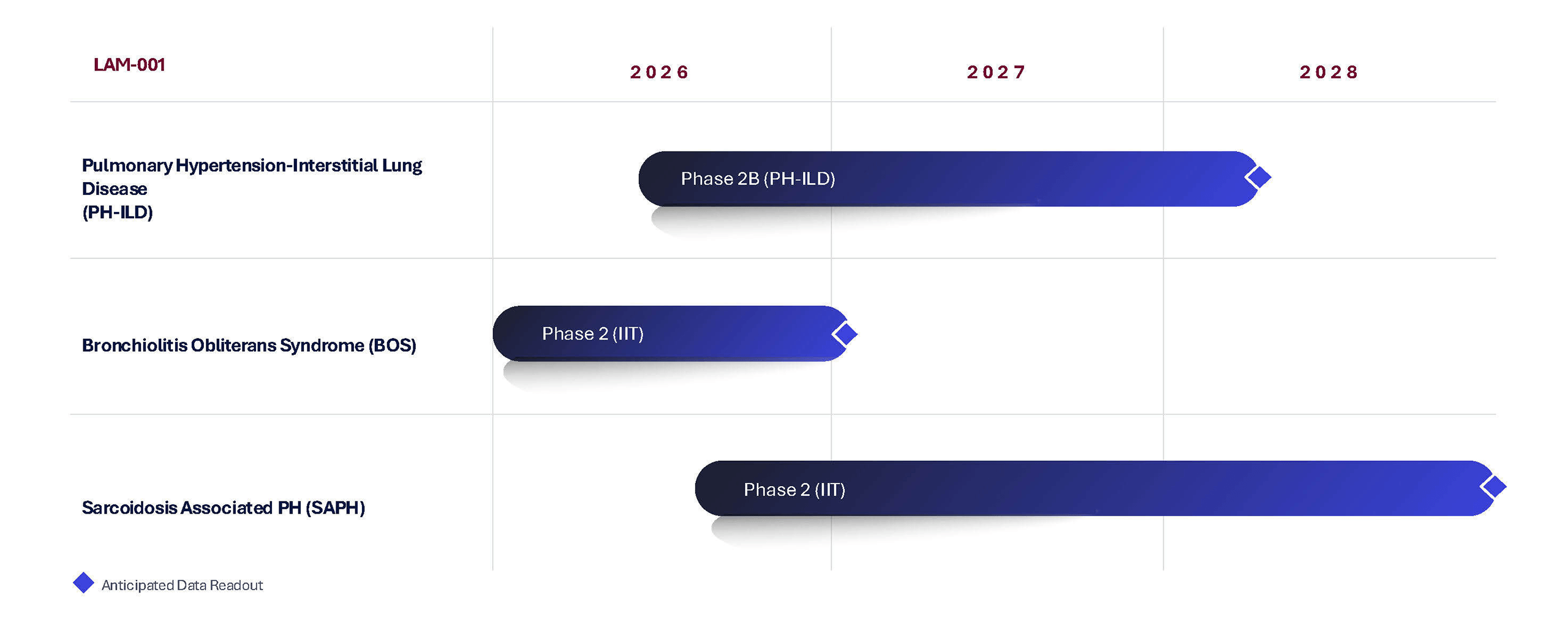
Building on these promising results, we are currently investigating LAM-001 in a Phase 2b trial in patients with PH-ILD.
LAM-001 FOR BOS
About BOS
Bronchiolitis Obliterans Syndrome post-lung transplant (BOS) is the most common cause of lung transplant failure, with approximately 50% of lung transplant recipients affected at five years and a BOS-free survival rate of 11% at ten years post-transplant. BOS manifests as increased fibrosis and inflammation, leading to scarring and narrowing of the small airways of the lungs. Unfortunately, the disease is progressive and culminates in irreversible airway obstruction and death over the course of approximately 2.5 years. By 2032, the BOS patient population in the US and Europe combined is estimated to be approximately 30,000.
Currently, there are no drugs approved by the U.S. Food and Drug Administration for this life-threatening condition.
mTOR Signaling in BOS
Investigating LAM-001 for BOS
LAM-001 is currently being investigated in an investigator-initiated Phase 2 study in patients with BOS.
LAM-001 FOR SAPH
About SAPH
Sarcoidosis is a disease characterized by the growth of abnormal masses of cells called granulomas throughout the body. In roughly 15% of cases, patients will develop sarcoidosis-associated pulmonary hypertension (SAPH), a severe complication in which elevated pressure in the pulmonary arteries places significant strain on the heart and lungs. Patients who develop PH in the context of sarcoidosis have an 8–10-fold increase in mortality compared to patients with pulmonary sarcoidosis alone. There are an estimated 60,000 patients with SAPH in the US and Europe.
Currently, there are no drugs approved by the U.S. Food and Drug Administration for SAPH.
mTOR Signaling in SAPH
SAPH exhibits the same core mTOR-linked pulmonary vascular remodeling seen in PH-ILD, including smooth muscle hyperproliferation and fibrosis, which drive increased pulmonary pressures and progressive right-heart dysfunction. Additionally, a growing body of translational research demonstrates that mTOR signaling is a central driver of pulmonary granuloma formation and persistence, a pathologic process that contributes to impaired lung and vascular function in SAPH. Chronic mTOR activation in macrophages is sufficient to drive granuloma formation, and mTOR inhibition reverses this pathology in non-clinical models. Recent clinical studies across pulmonary, cardiac, cutaneous, and multisystem sarcoidosis have also reported meaningful improvements with rapamycin treatment, further supporting the therapeutic potential of mTOR inhibition in patients with SAPH.
Investigating LAM-001 for SAPH
Building on these findings, we plan to evaluate LAM-001 in a Phase 2 clinical trial for patients with SAPH, which we expect to initiate in late 2026.